

Most wooden ornaments are light enough for a Christmas tree. A flat piece around 3 mm thick usually weighs only a few grams to a few tens of grams, and the common rule of thumb among makers is to stay under 2 oz (about 57 g) per ornament. Weight depends on three things: the species, the volume of wood, and how much moisture it holds. Once you know those, you can estimate any ornament before it arrives and hang it where the branch can carry it.
TL;DR
- Keep each ornament under about 57 g (2 oz); many makers aim for 28 g (1 oz) or less, according to a woodturners’ forum thread.
- Thickness matters more than the species. Around 3 mm is a practical starting point for a single-layer wooden ornament.
- Maple, walnut and oak sit in a narrow density band (roughly 640 to 720 kg/m³), so a size and thickness comparison tells you more than the wood name.
- Hang heavier pieces close to the trunk on sturdy branches, and use thinner tips for lighter ones.
- Dry, stable rooms keep wood from cracking, so storage affects durability as much as weight does.
Table of Contents
- How much does a wooden ornament weigh?
- What affects the weight of a wooden ornament?
- How size and thickness change the weight
- Will a wooden ornament be too heavy for a Christmas tree?
- What affects durability?
- Storing wooden ornaments so they last
- Weight and families with children
- Choosing a Thearboretum set
- Quick checklist before you buy any wooden ornament
- FAQ
- Sources
How much does a wooden ornament weigh?
There is no single figure, because “wooden ornament” covers everything from a 3 mm flat disc to a chunky turned bauble. What you can do is work it out. Weight is volume multiplied by density, and both are easy to find.
Here is a worked example. Take a flat, single-layer ornament that is 10 cm tall, 8 cm wide and 0.3 cm thick. A solid rectangle that size is 24 cm³. Real ornaments are shaped, so a tree or star outline fills perhaps half to two thirds of that rectangle, but the solid block gives you a safe upper limit.
| Wood | Typical density at 12% moisture | Upper estimate for the 24 cm³ block |
|---|---|---|
| Walnut | 640 kg/m³ | about 15 g |
| Maple | 700 kg/m³ | about 17 g |
| Oak | 720 kg/m³ | about 17 g |
The densities come from WoodCalcs’ timber weight calculator, and the grams are our own arithmetic (1 kg/m³ equals 0.001 g/cm³). Even before you cut away the outline, the block sits far below the 57 g ceiling. A flat ornament of this size is therefore very light.
The picture changes when the piece gets deeper. Double the thickness and you double the weight. Make it 6 cm wide and 12 cm tall and 1.5 cm deep, and the same oak block is about 130 g, which is well beyond what a thin branch tip should carry.
Real-world reference points
Small, flat wooden pieces are not far from other lightweight decorations. One manufacturer lists its 2023 holiday ornament at about 1 oz, but figures like this vary by product, so weigh your own pieces on kitchen scales when you can. A set of digital scales that reads to the gram is cheap and settles the question in seconds.
What affects the weight of a wooden ornament?
Three factors decide the number on the scales: species, moisture and dimensions. Of the three, dimensions give you the biggest swings.
Species and density
Hardwoods differ less than people expect. Whitmore’s Timber gives European oak and European beech as about 720 kg/m³ and Croatian black walnut as about 640 kg/m³. In the WoodCalcs species chart, hard maple is 705 kg/m³ and Scots pine, a softwood, is 510 kg/m³.
So swapping walnut for oak in the same shape changes the weight by roughly 12%. Swapping a 3 mm ornament for a 6 mm one changes it by 100%. When you compare ornaments, compare size and thickness first.

Moisture content
Wood is hygroscopic: it takes up and gives off water. TRADA, the UK’s timber research body, names moisture content as one of the most important factors affecting weight, strength, workability and dimensional stability. The effect can be sizeable. WoodCalcs adds around 4% to the weight of air-dried timber (20% moisture) and around 45% for green timber. A properly dried ornament from a heated home sits at the low end of that range.
Natural variation
No two pieces of wood are identical. A US-based calculator notes that individual boards of the same species commonly vary by 10% or more in density. Knots, dense grain and resin-rich streaks all add a little. That is part of why two handmade ornaments of the same design can differ by a gram or two on the scales, and why we see it as character rather than a flaw.
How size and thickness change the weight
Thickness is the lever makers pull most often. A guide from Laser Cut File Atlas suggests that around 3 mm is a practical starting point for many single-layer ornaments. It feels substantial without being unnecessarily heavy. Material of 1.5 to 2 mm is light and delicate, and 4 to 6 mm suits larger plaques better than delicate tree decorations.
Layering adds up quickly. The same guide points out that three layers of 3 mm wood make a piece roughly 9 mm deep before glue or finish, which can look luxurious on a stand but feel bulky on a tree.
A quick guide to what that means in practice:
| Thickness | Feel and use | Weight relative to 3 mm |
|---|---|---|
| 1.5 to 2 mm | Delicate, fine detail, easily snapped | about half to two thirds |
| 3 mm | Good balance for tree hanging | baseline |
| 4 to 6 mm | Bold, better for larger plaques and shelves | about 1.3 to 2 times |
| 9 mm (three layers) | Display piece, sturdy but bulky on a branch | about 3 times |
The last column is simple proportion: for the same outline, weight rises in line with thickness.
Size matters in the other two dimensions too. A listing that gives only the thickness, as some do at 3 mm, tells you about the edge, not the height or the overall bulk. Always look for height and width as well, then use the arithmetic above. If you want to go bigger on purpose, our guide to oversized wooden ornaments explains how to avoid buying a piece that overwhelms your tree.
Will a wooden ornament be too heavy for a Christmas tree?
Usually not. In a forum thread among woodturners, the consensus was that 2 oz is at the top end for an ornament, that keeping under 2 oz is a good rule of thumb, and that some makers aim for 1 oz or less. One contributor weighed his flat ornaments, which were 2.75 inches by 7.5 inches, at just under 2 oz. That is anecdotal, but it matches the arithmetic above: flat wooden pieces are generally light.
What matters more than a single ornament is the total load and where it sits.
- Branch strength. Artificial branches are thinner than they look, and natural ones taper. The outer 30 cm carries the least. Our guide to how to hang heavy ornaments safely explains why to avoid the top 30 centimetres of the tree for anything weighty.
- Distribution. A forum administrator in the same thread noted that many heavy ornaments need spreading evenly around the tree, or it could topple. Put the heaviest pieces low and near the trunk.
- Hanging method. A thin cord or hook that spreads load across a branch beats a tight loop at the tip.
- Hole and bridge strength. The hanging hole needs enough wood around it to resist tearing, and the narrowest bridge in a design is often the weak point. Check antlers, snowflake arms and lettering joins at the finished size.
A practical test: if a branch dips more than a centimetre or two with the ornament on, move it nearer the trunk or to a stronger branch.
A simple weight budget
If you want to dress a 7 ft tree with wood, aim for an average of 20 to 30 g per piece. At 50 ornaments that is 1 to 1.5 kg in total, which a well-built tree handles without trouble, as long as the weight is spread out. Mix in a few lighter pieces for the outer branches and keep the chunkier ones inside.

What affects durability?
Lightness and durability pull against each other. A thinner piece weighs less but snaps more easily. The aim is the thinnest piece that still survives handling, and a few design details help.
- Grain direction. Laser Cut File Atlas notes that grain direction influences strength in thin wood. Rotating a design so a delicate feature follows the grain gives it better support.
- Rounded transitions. Rounded internal corners tend to survive handling better than sharp notches.
- Hole placement. A hanging hole set well inside the edge resists tearing.
- Finish. Wood swells with moisture while paint and varnish tend to shrink, and the reverse happens when wood dries. FineArt UK Magazine explains that this mismatch makes paint easier to crack and detach.
These same features are why a good wooden ornament gives a sense of solidity at a low weight. If you also enjoy bold, sculptural pieces for walls, a wooden wall decoration lets you show off heavier timber work without asking a tree branch to carry it.
The role of humidity
Wood moves with the air around it. In a conservation course for wood, Sarah Staniforth notes that dry conditions under 50% relative humidity cause shrinkage that leads to cracking and breakage of wood. She also notes that in the UK, raising the temperature by 5°C lowers the average relative humidity to roughly 60%. That is why ornaments left near a radiator in a centrally heated house are at more risk than ones in a cool hallway.
Use that when you place your tree. Keep it away from radiators, fireplaces and vents, and stand it against an inside wall rather than a cold outside one.
Storing wooden ornaments so they last
The Western Australian Museum’s preventive conservation manual for wood is written for museum objects, but its principles scale down well to a box in the loft or a cupboard:
- Aim for relative humidity of 40 to 60% and avoid big swings.
- Keep temperature in the 15 to 25°C range, avoiding sharp changes.
- Avoid direct contact with outside walls, and keep wood away from fireplaces, heaters, air conditioning vents and doorways.
- Keep humidity below 65% so fungal attack does not start.
- Keep unpainted and undyed wood out of strong light.
For a UK home, that means an interior cupboard or a wardrobe shelf in preference to a damp garage or a hot loft. Wrap each piece in acid-free tissue, lay them flat in a rigid box, and do not stack heavy items on top. We cover cleaning, storing and protecting in more detail in our wooden ornament care guide, and if your pieces get dusty or sticky, read how to clean wooden ornaments before you reach for a damp cloth.
Weight and families with children
Light pieces are easier to hang low, but weight is only one part of child safety. A small, sharp-pointed ornament is a bigger concern than a larger, smoother one. That is why some of our trees are made with dull points and food-safe finishes in the child-friendly options. For tips on setting up a tree in a home with little ones, see our guide to child friendly Christmas tree safety, and our explanation of dull point ornaments. If you want pieces at child height, the ornament display ideas page shows how to arrange wood that kids can reach.
Our view on weight
We make wooden trees from maple, walnut and oak because these hardwoods are dense enough to hold a crisp shape and light enough, in a sensible thickness, to sit comfortably in your home. We pay attention to natural knots and grain because they make each piece a one-of-a-kind object, and we treat the variation in weight that comes with that as part of the charm.
Our advice is to stop worrying about whether wood is “too heavy” and start thinking about where each piece lives. A small tree belongs on a shelf, a mantel or a table. A set of several works as a grouped display. Pieces designed for children carry dull points and food-safe finishes, so they suit families as well as collectors.
If you are buying a gift, pick a design you would be happy to see on a surface all year, not only in December. Solid wood trees are meant to be displayed, kept and passed on.
Josh
Choosing a Thearboretum set
Our trees are handmade from sustainably sourced hardwoods such as maple, walnut and oak, and every piece shows its own knots and textures. The Woodland set is $126 and the larger Forest set is $239. Child-friendly versions of both are available, and a Woodland Oak edition sits in the same collection.
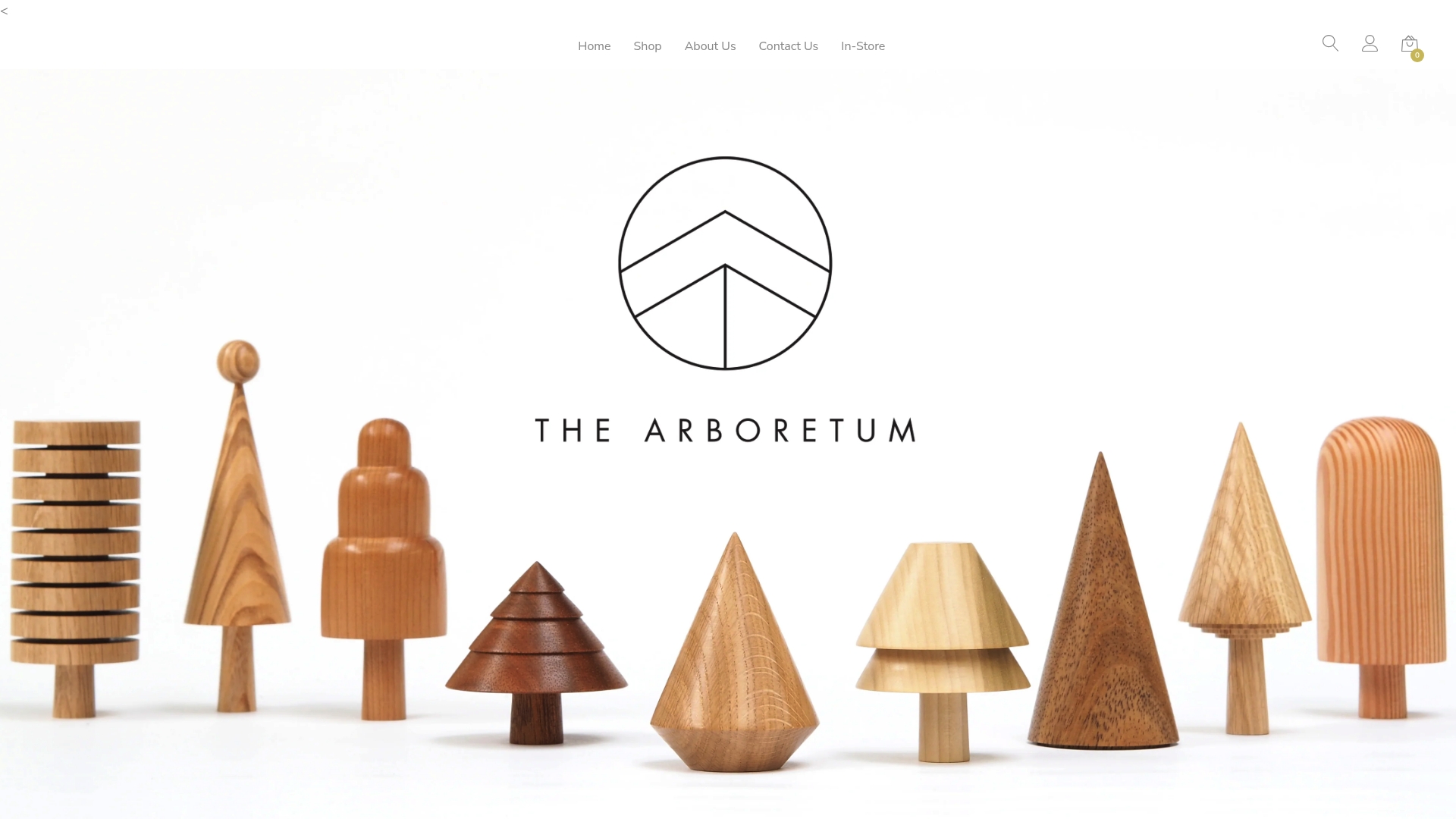
If you want a particular size or combination, our custom collection starts with a Custom Single Tree at $28. For a table or shelf, the new trees collection includes a Floating Shelf and a Tree Candle, each $40. To plan a tabletop display, see our guide to styling a wooden tabletop tree.
Quick checklist before you buy any wooden ornament
- Find height, width and thickness, then estimate weight using density times volume.
- Look for thickness of about 3 mm for a single flat ornament meant for hanging.
- Check the hanging hole sits well inside the edge.
- Decide where it will hang: outer tips for light pieces, near the trunk for heavier ones.
- Plan storage in a dry interior cupboard, not a damp garage.
- For gifts, read our guide to UK safety, FSC proof and packing.
FAQ
How many grams does a typical wooden ornament weigh?
A flat, single-layer wooden ornament of about 10 by 8 cm at 3 mm thick comes to roughly 15 to 17 g at most in maple, walnut or oak. Cut-out shapes weigh less than that solid block. Thicker, layered or turned pieces can weigh several times more, so check the dimensions.
Is oak heavier than maple or walnut?
Only slightly. WoodCalcs lists oak at 720 kg/m³, maple at 700 and walnut at 640 at 12% moisture. For a small ornament that difference is a gram or two, so thickness and size matter far more.
Do wooden ornaments crack or warp?
They can if they are kept in very dry or fast-changing conditions, because wood expands and contracts with humidity. Keep them away from radiators and store them in a stable, interior space. Humidity of 40 to 60% is the range recommended for wooden objects in museum guidance.
How many wooden ornaments can I put on a tree?
The limit is the load on each branch rather than the count. Spread pieces evenly, hang heavier ones near the trunk, and keep an average of 20 to 30 g per ornament as a comfortable budget for a full-sized tree.
Sources
- AAW Christmas Ornament Weight, American Association of Woodturners forum
- TRADA Wood Information Sheets
- European Hardwoods, Whitmore’s Timber
- Wood Species Properties Chart, WoodCalcs
- Timber Weight Calculator, WoodCalcs
- Wood Weight Calculator, Builderology
- How to Choose Wood and Thickness for Laser Cut Christmas Ornaments, Laser Cut File Atlas
- Wood conservation: relative humidity, FineArt UK Magazine
- International Course on Wood Conservation Technology, Sarah Staniforth, IIC
- Preventive Conservation, Western Australian Museum
Follow Us On Social