

A knot is the place where a branch once grew out of the tree, cut through and left visible in the timber. Some knots are tight, sound and part of the wood’s character. Others are loose and can fall out. Knowing which is which tells you whether a dark swirl in a wooden piece is a feature to enjoy or a weak spot to avoid. In our handmade wooden trees we select and finish pieces so the knots stay as the visible pattern of the tree they came from.
TL;DR
- A knot is the remains of a branch buried in the trunk. The UK government’s woodworking glossary defines it exactly that way.
- Live branches make tight (red) knots that grow into the surrounding wood. Dead branches make loose (black) knots that can shrink and drop out.
- Knots are darker and denser than the wood around them, which is why they look so distinctive.
- In construction timber a knot is graded as a defect. In decor and craft it is often the feature people choose a piece for.
- Sound, smooth-finished knots are fine in ornaments and gifts. Look for a knot that sits firmly and a surface that feels even to the touch.
Table of Contents
- What a wood knot actually is
- What causes knots to form
- The types of wood knots
- What a knot means for appearance and strength
- How to tell a good knot from a poor one
- Are knots safe in ornaments and children’s pieces?
- Why knots suit handmade wooden decor
- Our view on knots
- Choose a tree with its own pattern
- FAQ
- Sources
What a wood knot actually is
Picture a tree as a stack of growth layers, with a new ring added each year. A branch starts from a bud on the main stem, and as the trunk thickens, the base of that branch is wrapped in new wood. Inside the trunk the branch leaves a cone of branch wood pointing back towards the centre. Hoadley’s chapter on abnormal wood describes exactly this: as the trunk’s girth increases, a cone of branch wood develops, and it shows up as a knot when the log is sawn.
That is why a knot looks different depending on how the board is cut. Slice across the cone and you see a round or oval spot. Slice along it and you see a long, elongated shape. A professional UK timber design guide notes that knots are among the most abundant wood features and that they form cones towards the pith, the soft centre of the stem, rather than existing only on the surface.
That also explains a surprise for many people: a knot can sit inside a piece of wood without ever reaching the surface. Researchers at Napier University’s Centre for Wood Science and Technology use 3D imaging to see knots inside timber that you cannot see from outside.
You meet knots everywhere in wood, from floorboards to furniture. Solid wood surfaces such as solid wood worktops show their grain and knots too, and the same logic applies there: the knot is simply the trace of a branch.

What causes knots to form
Knots are a normal part of how trees grow, not damage or disease. Two things produce them.
Branching. Every branch begins as a lateral bud on a twig. As the tree grows, the branch grows too, and its rings connect with those of the trunk.
Shade and self-pruning. As a tree grows taller, its crown shades the lower, older branches, so they die. According to Wood Based Panels’ piece on how knots form, these dead branches are gradually swallowed by the trunk’s increasing girth. The result is a pattern: the clear, knot-free wood is found in the outer trunk, while the central part of the tree holds the darker dead knots.
The tree keeps adding wood around the stub for decades. A knot is therefore a record of the tree’s early life, which is partly why we find them worth keeping.
The types of wood knots
People sort knots in two ways: by what the branch was doing when the tree grew around it, and by the shape the saw reveals.
By the branch: tight (red) and loose (black) knots
This is the distinction that matters most.
| Type | Also called | What happened | What it looks like | Behaviour |
|---|---|---|---|---|
| Tight knot | Intergrown, sound, live or red knot | The branch was alive, so its rings grew together with the trunk’s | Round or oval, often slightly reddish, surrounded by circular growth rings | Stays firmly in place |
| Loose knot | Encased, dead or black knot | The branch had died, and the trunk grew around the stub | Darker, often with a ring of bark around it | May shrink and loosen, sometimes falling out and leaving a hole |
The Northern Woodlands explanation of red and black knots says red knots form when branch and trunk are both alive and growing, so the rings are completely intergrown. Black knots result when the limb has died and the trunk grows around it, often with bark or pitch pockets separating the dead wood.
The Woodworking Network adds that a black knot shrinks more than the surrounding wood as it dries, which is why it commonly becomes loose.
Wood Magazine describes tight knots as dark, dense circular or oval spots with irregular grain, and loose knots as darker, shrunken and detached, sometimes loose enough to remove by hand.
By the cut: round, spike, splay and pin knots
The same knot looks different depending on the saw cut.
- Round knots appear round or oval, typically on flatsawn boards.
- Spike knots are cut lengthways, so they stretch across the face of the board.
- Splay knots are also elongated, and connect to the edge (the arris) of the piece. The UK guide from MHS Southern separates splay and spike knots on exactly this basis.
- Pin knots are the small ones, under one inch (about 25 mm) in diameter according to Hoadley.
So when someone asks for “four types of knot”, the useful answer is: two by branch (tight and loose) and several by shape (round, spike, splay, pin), all describing the same underlying thing.
What a knot means for appearance and strength
Why knots look darker
Knots are often darker than the surrounding wood because they contain more lignin, the natural compound that stiffens wood cell walls, according to the MHS Southern guide. The grain also swirls around them, which gives the characteristic eye-like pattern.
Strength: it depends on the knot
The grain around a knot runs at an angle to the rest of the board, and that can create weak spots. The same guide notes, however, that mechanical properties are not necessarily related to the size and number of knots, so a knotty piece is not automatically a weak one.
A loose, encased knot is the more serious case. Northern Woodlands notes that these knots are generally considered more serious defects than red knots because they are poorly connected to the surrounding wood and can drop out, leaving a knothole. A tight knot stays put but can develop small radial cracks, as Hoadley explains.
In practical hardwood grading, the National Hardwood Lumber Association says a knot is typically only a problem when it leads to tear-out or is unsound. A sound knot, in its definition, is solid across its face, as hard as the surrounding wood and showing no sign of decay.

A defect in a plank, a feature in a craft
Commercial grading treats every knot as a defect, because it judges boards by size and clear areas. Hoadley points out that many beautiful works of craftsmanship have been made using or even featuring knots. The craftsperson’s task is to understand how the knot relates to the rest of the wood and to place it where it adds to the piece.
That is the difference between structural timber and decor. In a roof beam you want predictability. On a shelf or in an ornament you want a piece that looks like it came from a particular tree. If you like this look in your home, our guide to wood grain decor ideas shows how to use it in a room.
How to tell a good knot from a poor one
Whether you are choosing timber, a wooden gift or a decoration, the checks are simple.
- Look at the edge of the knot. A tight knot merges into the wood with continuous rings. A dark ring of bark around the knot suggests a dead branch and a looser fit.
- Press gently with a thumb. A fixed knot should not move. The NELMA Grader Academy describes a fixed knot as one that stays in place but is movable under pressure, commonly called a clicker, which is the kind to avoid.
- Run a finger over it. The surface of a well-finished piece feels continuous, with no raised edges, deep cracks or gaps.
- Check for holes. A knothole means a loose knot has already fallen out.
- Consider the position. A knot near an edge or thin section is more likely to split than one in the middle of a solid area.
The more detailed guide to checking wood knots for safety covers timber and ornaments side by side.
Are knots safe in ornaments and children’s pieces?
For decor and gifts, a sound, tight knot that has been sanded and finished is part of the wood, not a hazard. What matters for any wooden object a child will handle is the finish and the shape: smooth surfaces, no cracks or loose parts, and no sharp points.
That is how we approach our child-friendly options. They have dull points and food-safe finishes, and they come in the same Woodland and Forest sets as our standard trees. Parents who would like a child to play with a tree can choose Woodland, Child Friendly or Forest, Child Friendly, and the natural knots and textures stay visible.
Why knots suit handmade wooden decor
Mass-produced decorations are usually cut from uniform stock, with the knots avoided or hidden. A handmade piece does the opposite. Because we work with sustainably sourced hardwoods such as maple, walnut and oak, the grain, knots and textures differ from one tree to the next. Maple tends to give a lighter, calmer pattern and walnut a darker, richer one: our maple versus walnut comparison explains how to choose between them.
For collectors, that variation is the point. Two trees from the same set will never be identical, so each carries a pattern that belongs to it alone. For gift-givers, it means the present has a story: the knot is a branch that grew decades ago.
Our view on knots
We do not see knots as something to hide. A knot is where a branch once grew, and it gives each tree its own pattern. When we choose and shape wood, we look for the knots that sit firmly and look good, and we leave them visible.
Commercial grading rules exist for a good reason: a beam has a job to do. A decoration has a different job, which is to be looked at. That is why we make trees from maple, walnut and oak, and let the natural knots and textures show.
If you want a piece that looks like it came from a real tree and not from a factory, a knotted tree is a good place to start. Each one is different, and that is exactly what we want.
Josh
Choose a tree with its own pattern
If you want to bring natural knots into your home, our Woodland sets start at $126 and the larger Forest sets at $239. You can also order a Custom Single Tree for $28 if you want one piece for a shelf, a gift or a collection. We also make a Floating Shelf and a Tree Candle at $40 each.
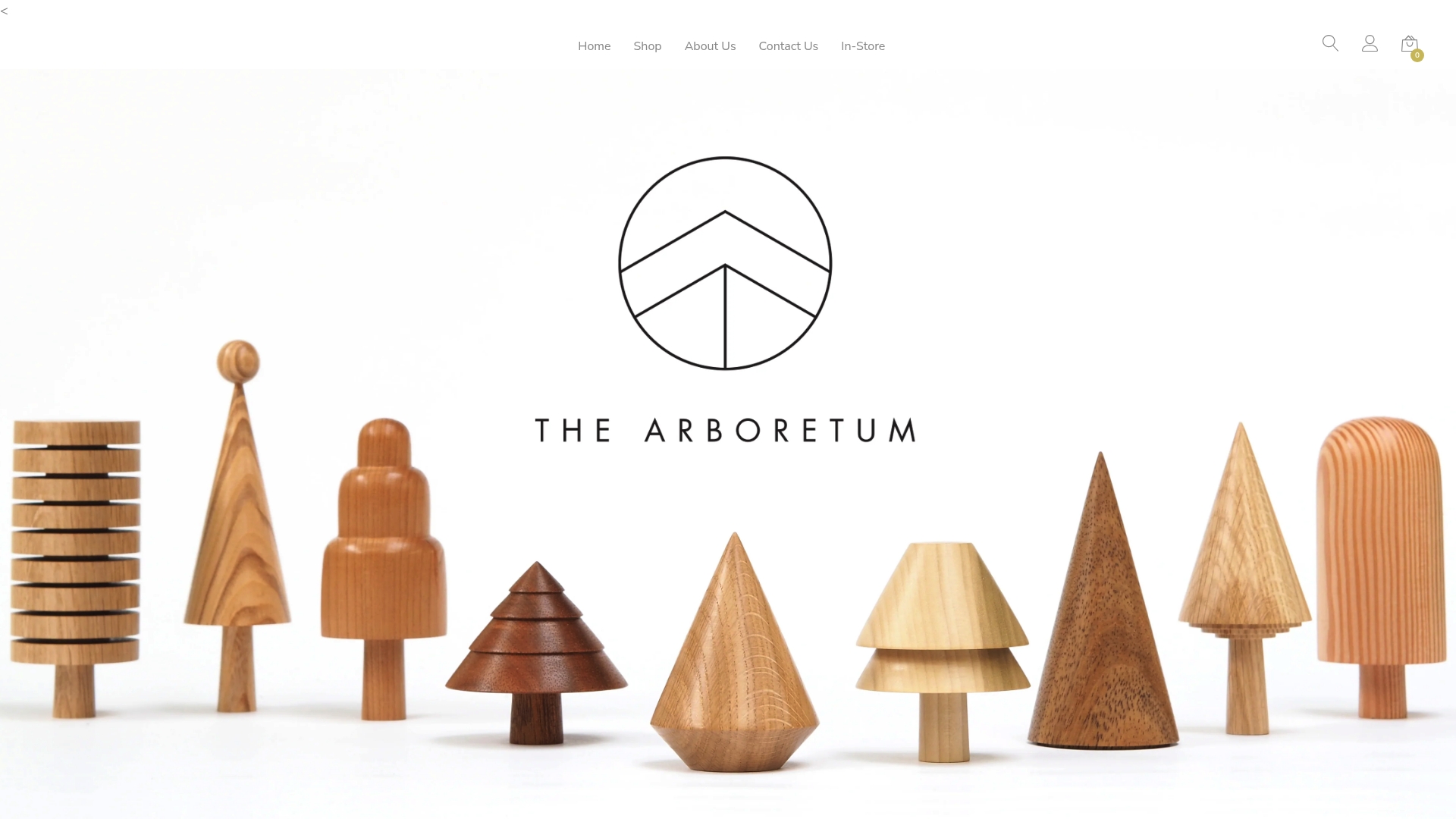
Browse the Woodland sets, the Forest sets or the custom designs. If you are choosing a gift, our guide to custom wood ornaments walks through the options.
FAQ
Why do you get knots in wood?
Because trees grow branches, and as the trunk thickens it grows around the base of each one. When the log is sawn, the buried branch shows as a knot. The UK government’s glossary defines a knot as the remains of a branch in timber.
What is the difference between a tight knot and a loose knot?
A tight knot comes from a living branch, so its growth rings join with the trunk’s and it stays firmly in place. A loose knot comes from a dead branch, which the trunk grew around. It may shrink as it dries and can fall out, leaving a hole.
Do knots make wood weaker?
Not always. The grain around a knot changes direction, which can create a weak spot, but the MHS Southern guide says mechanical properties are not necessarily related to the size and number of knots. Loose, encased knots are the ones that cause most concern.
Can a knot be inside the wood without showing?
Yes. Knots are cones of branch wood that run towards the centre of the trunk, so they can exist inside a piece without reaching the surface. Napier University’s researchers use 3D imaging to reveal them.
Why do some knots look darker than the rest of the wood?
Knot wood contains more lignin and is usually denser, and its grain runs in a different direction to the surrounding wood. Both effects change how it takes light and finish, which gives knots their darker, eye-like look.
Sources
- Glossary of wood and woodworking terms (UK government)
- Abnormal Wood, R. Bruce Hoadley (Fine Woodworking)
- Wood Features and Defects (MHS Southern)
- Intro to wood structure and grading (Napier University)
- The story of knots (Wood Based Panels)
- Red knots and black knots (Northern Woodlands)
- Red knots and black knots (Woodworking Network)
- Making Nice with Knots (Wood Magazine)
- Defining and Measuring Knots in Hardwood Lumber (NHLA)
- Characteristics 101: Knots and Wane (NELMA Grader Academy)
Follow Us On Social