

Burl wood, sometimes called burr wood in Britain, is the timber cut from a burl: a rounded, tumour-like growth on a tree caused by abnormal cell proliferation rather than disease or rot. It produces some of the most highly figured, one-of-a-kind wood available, prized for veneer, inlay, turnery and small decorative objects. That figure exists because the tree’s growth cells go haywire in response to stress, injury or infection, packing years of chaotic cell division into one dense lump.
TL;DR:
- Most burl wood comes from a limited range of hardwoods like maple, walnut, and cherry, with large, defect-free specimens being quite rare.
- Burl grain patterns are unpredictable and vary widely, making each piece unique, with specific figures like cat’s paw and bird’s-eye often cited.
- Working with burl requires sharp tools, slow cutting, and stabilizing techniques due to its highly interlocked and dense grain that causes tearout and chipping.
- Ethical sourcing is crucial, as many large burls are stolen from protected forests, so buyers should verify provenance and prefer reclaimed or certified material.
- Buying finished burl or knotty hardwood pieces from responsible sources offers the same visual appeal without the sourcing risks or need for complex processing.
Table of Contents
- What causes a burl to form on a tree?
- Why does burl grain look so unpredictable?
- Which tree species produce the best burls?
- How is burl wood used in furniture and decorative objects?
- What makes burl wood difficult to work with?
- Is it ethical to buy burl wood?
- Publisher perspective: crafting with figured wood, the honest way
- Do burls actually hurt the tree they grow on?
- What role has burl wood played in craft history?
- How can you tell real burl wood from an imitation?
- How should you care for burl wood pieces at home?
- The conventional wisdom oversells raw burl, and undersells the risk
- How to buy a ready-made knotty maple piece from The Arboretum
- Sources
What causes a burl to form on a tree?
A burl starts with hyperplasia, an abnormal proliferation of cells in the vascular cambium, the thin layer just beneath the bark responsible for a tree’s growth. Instead of the orderly, concentric growth rings you’d see in a normal trunk cross-section, the cambium in a burl multiplies erratically, producing a dense, swirling mass of woody tissue. The Home Garden Education Office at the University of Connecticut describes burls as hard, woody swellings that usually stay covered by ordinary bark, which is why a tree carrying a large one can look almost normal from a distance.
Several triggers set this process off, and often more than one is at work on a single tree:
- Physical injury, such as a branch break, animal damage, or lightning strike
- Fungal or viral infection that disrupts normal cambium signalling
- Insect boring or egg-laying that irritates the surrounding tissue
- Dormant, undeveloped buds that never sprouted but keep dividing beneath the bark
Burls differ from galls, which tend to be softer, smaller, and driven almost entirely by insect or mite activity. A Wikipedia’s overview of burls confirms this abnormal cell growth can appear on a trunk, a branch, or even a root, and sizes range from a fist-sized knob to a growth several feet across.
Why does burl grain look so unpredictable?
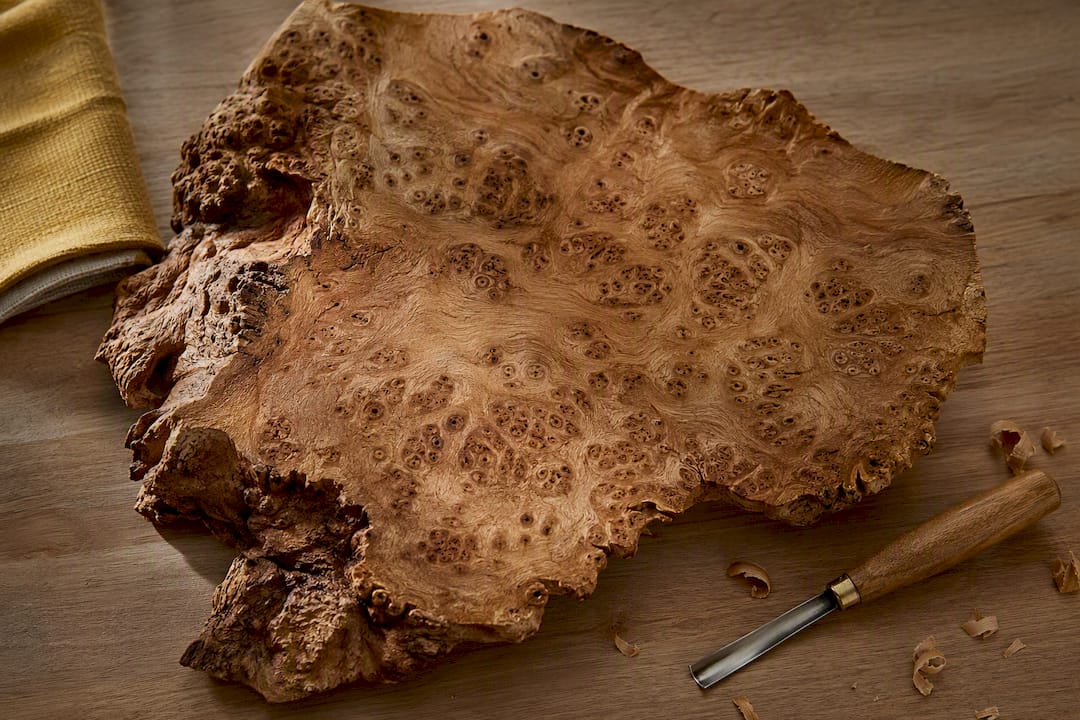
The chaos inside a burl comes from clusters of dormant buds, often called “eyes,” embedded throughout the woody mass. Each eye represents a tiny growth point that never became a branch, and the fibres around it twist and interlock rather than running in one direction. That’s the anatomical reason burl grain never behaves like grain in a straight-sawn plank.
Certain patterns recur often enough that woodworkers have named them:
- Cat’s paw figure, with rounded, overlapping eye clusters
- Bird’s-eye style swirls, tighter and more uniform
- Cluster burl, showing dense groupings of eyes packed close together
Woodworkinghistory notes that the figure inside a burl stays a mystery until the piece is actually cut open. Two burls from the same tree species, even the same tree, can reveal completely different patterns.
Pro Tip: That interlocked fibre direction also makes burl notably dense and tear-resistant compared with straight-grained timber from the same species, which is exactly why it holds fine detail so well in turning and carving.
Which tree species produce the best burls?
Most commercial burl comes from a handful of familiar hardwoods, though a few exotic species command serious premiums among collectors:
- Maple, prized for turnery and fine veneer, often showing tight bird’s-eye clusters
- Walnut, favoured for trim and panelling thanks to its rich brown tones
- Cherry, valued for warm colour and smaller decorative pieces
- Oak, generally coarser but still popular for rustic furniture accents
- Elm, historically common in British burl work
- Redwood, known for producing some of the largest burls found in North America
- Amboyna and camphor, rarer exotic species that fetch premium prices for their intense colour and figure
Large, defect-free burls remain genuinely uncommon. Most that reach the market carry cracks, insect tunnels, or bark inclusions that limit their usable size, which is part of why a clean, sizeable burl commands attention the moment it appears at a timber auction.
How is burl wood used in furniture and decorative objects?
Burl’s appeal comes down to one thing: figure that ordinary lumber simply cannot produce. That drives a fairly consistent set of applications across furniture making and decorative craft.
- Veneer and inlay remain the most common use, since thin-sliced burl lets makers cover large surfaces like tabletops, cabinet doors, and dashboard trim while conserving scarce material.
- Turned bowls and small sculptures show off the figure in three dimensions, letting the eyes and swirls catch light from every angle.
- Musical instrument trim, including guitar tops and pickguards, uses burl for both looks and its dense, resonant qualities.
- Accent furniture and tabletops built around a single dramatic slab, where the figure itself becomes the design rather than a decorative afterthought.
Price and collectability track three things closely: how striking the figure is, how large the usable slab or block turns out to be, and how free it stays from cracks, voids, and insect damage.
What makes burl wood difficult to work with?
The same interlocked grain that creates burl’s figure also makes it genuinely awkward to cut. Because fibres run in every direction at once, there’s no consistent “with the grain” pass, so tearout and chipping are a constant risk on both hand tools and machines.
Woodworkers who specialise in burl rely on a fairly specific toolkit:
- Very sharp cutters, kept sharper and changed more often than for straight-grained stock
- Slow feed rates on saws and slicers to reduce ripping
- A sacrificial backing board when slicing thin veneer sheets
- Thin CA glue or epoxy stabilisers on fragile or punky sections before final cuts
On the lathe, Canadian Woodworking’s guide to burl techniques recommends reduced spindle speeds and a light touch, since burl can shatter unpredictably where straighter timber would simply cut clean.
Pro Tip: Sand through a full progression, at least up to 400 grit, before applying a penetrating oil or thin lacquer. Burl figure disappears under a thick film finish, but it comes alive under something that soaks in and lets light travel into the grain.
Is it ethical to buy burl wood?
Burl’s rarity has a dark side. Because large, well-figured burls take decades to develop and cannot be reliably induced or sped up, the market stays permanently short of supply, and that scarcity has driven real theft. Poachers have cut valuable burls from living trees in protected forests, leaving open wounds that invite decay and sometimes kill the tree outright.
Responsible buyers have workable alternatives:
- Reclaimed burl from trees that have already fallen naturally
- Material from legally felled trees, cleared as part of routine forestry work
- Suppliers who can document a chain of custody back to a specific harvest
Before buying, it’s worth asking a seller directly where the burl came from, whether it’s certified, and how long they’ve sourced from that supplier. Fresh, rough cuts at height on a tree that’s clearly still standing are a red flag worth reporting rather than buying.
Publisher perspective: crafting with figured wood, the honest way
At Thearboretum, we’re drawn to knotty maple and walnut for a straightforward reason: the natural knots and irregular grain patterns in these woods echo the same visual drama that makes true burl so collectable, without any of the sourcing risk. Every knot tells its own story, much like an eye cluster in a burl.
A few of our pieces lean into this directly:
- Knotty Maple Bush, built around dense clusters of natural knotting across a tree silhouette
- Knotty Maple Alpine, using tighter grain irregularities for a more refined finish
- Knotty Maple Drop, a smaller hanging piece where a single striking knot becomes the focal point
Every piece is hand-finished, and where a design suits children’s hands, we round the points and use food-safe finishes. Nothing leaves our workshop from wood taken illegally or under pressure from a living tree.
Do burls actually hurt the tree they grow on?
Generally, no. A burl is not a tumour in the cancerous sense, and it doesn’t spread through a tree’s tissue or systematically weaken its structure the way rot or a serious fungal infection can. Most trees carrying a burl live a completely normal lifespan, growing around the swelling for decades without any obvious decline in health.
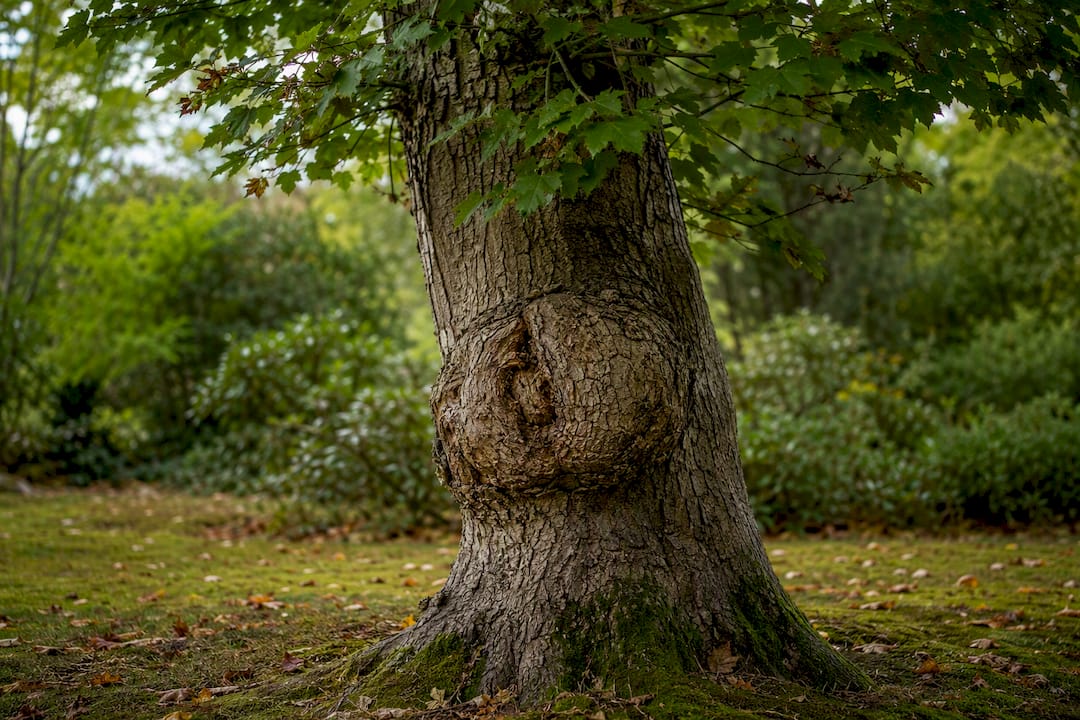
Where damage does happen, it’s almost always caused by removal rather than by the burl itself. Cutting a burl off a living tree opens a wound in the bark and cambium layer, and that wound becomes an entry point for decay fungi and pests. The University of Connecticut’s guidance on tree burls is direct on this point: burls are typically benign, and removing one from a standing, living tree causes far more harm than leaving it alone.
There’s a simple piece of tree-health guidance worth remembering if you’re a homeowner with a burl on a garden tree. Leave it in place. It won’t spread, it won’t kill the tree, and in most cases it adds character rather than risk. If a tree with a burl shows other signs of decline, thinning canopy, fungal fruiting bodies, or soft, crumbly bark elsewhere, that’s a separate issue worth a call to an arborist, not something caused by the burl itself. The swelling is simply the tree’s growth process going slightly off-script and then carrying on regardless.
What role has burl wood played in craft history?
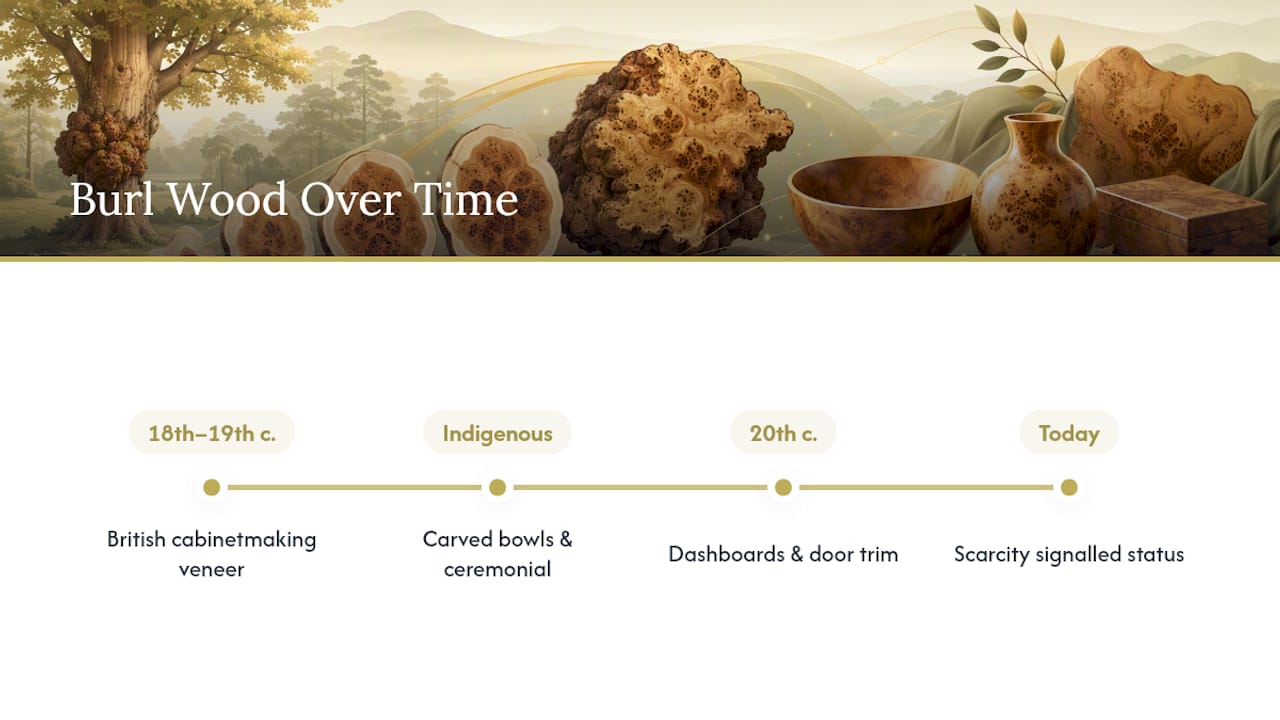
Burl wood has a longer history in fine craft than most people realise. Georgian and Victorian cabinetmakers in Britain used burr walnut and burr yew extensively for veneering bureaux, clock cases, and card tables, choosing it precisely because no other timber could produce that same restless, swirling surface. Burr walnut veneer in particular became a hallmark of quality furniture through the 18th and 19th centuries, appearing on everything from writing desks to gun cases.
Indigenous woodworking traditions in North America also used burl extensively, carving bowls and ceremonial objects from burl sections precisely because the interlocked grain resisted splitting under stress, an important practical quality long before it became a decorative preference. Automotive designers picked up the tradition in the 20th century, lining dashboards and door trim in burr walnut and burr elm as a shorthand for luxury that persists in some car interiors today.
What ties these uses together is scarcity meeting status. Burl was never abundant, never predictable, and never something a buyer could simply order to a specification. Owning a piece made from it signalled access to something genuinely uncommon, and that association between burl and craftsmanship has barely faded.
How can you tell real burl wood from an imitation?
Genuine burl has a few tells that manufactured look-alikes struggle to reproduce convincingly. Real burl figure is three-dimensional: the eyes and swirls sit at slightly different depths, and the pattern shifts subtly as you tilt the piece under light. Printed laminates and photo-veneer panels, by contrast, show a flat, repeating pattern that looks identical from every angle because it’s the same image tiled across the sheet.
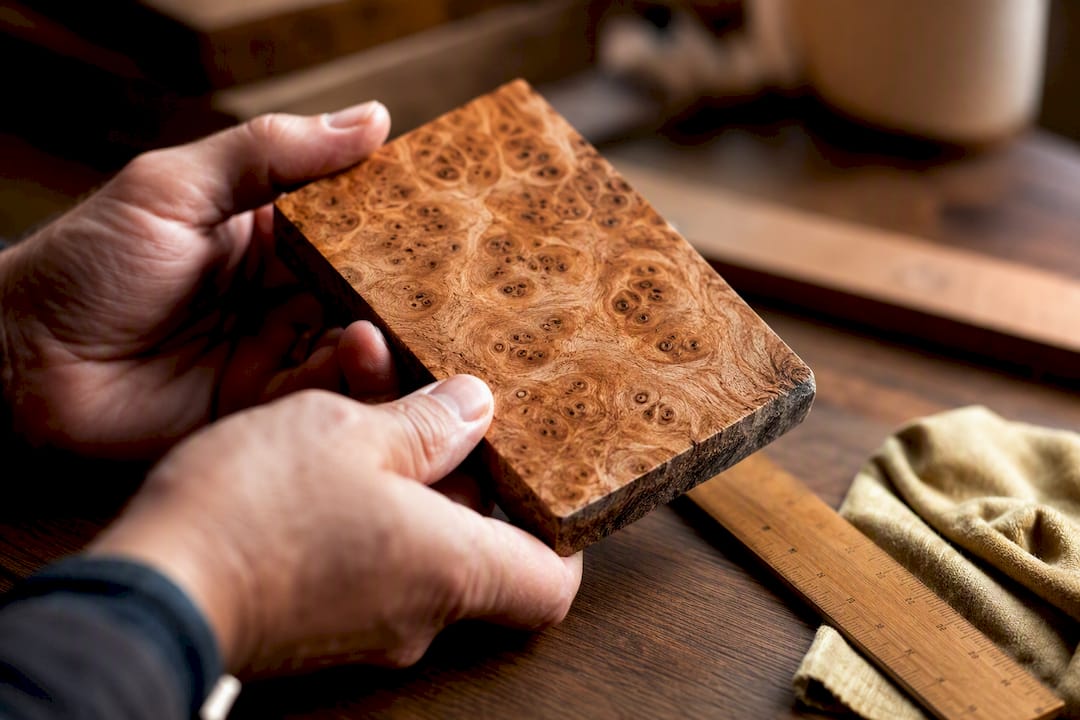
Run a finger across a genuine burl surface and you’ll often feel faint texture differences even under a smooth finish, since the underlying density varies from one patch of grain to the next. Weight is another clue. True burl, being extremely dense, feels heavier for its size than a veneered composite panel of the same dimensions.
Check the edges where possible. Real burl veneer, sliced thin and laid over a substrate, shows genuine wood grain running through its edge in cross-section. Printed or engineered veneer typically reveals a paper-thin decorative layer sitting on plain particleboard or MDF the moment you look at a cut edge or a worn corner.
If you’re assessing a piece for veneer or turning stock, WoodworkingHistory.com’s guide suggests checking for consistent eye clusters and minimal internal decay, since smaller, sound burls often suit turning perfectly well even when they’re too compromised for large veneer sheets.
How should you care for burl wood pieces at home?
Burl wood furniture and decorative objects need slightly gentler handling than plain-sawn timber, mostly because of how the finish interacts with that irregular grain. Direct sunlight is the biggest long-term risk, since UV exposure fades figure unevenly across a burl surface faster than it fades straight grain, leaving pale patches where the light hit hardest.
Keep pieces away from radiators, direct sun through south-facing windows, and anywhere humidity swings sharply, such as near an unvented bathroom. Burl’s dense, twisted grain expands and contracts unevenly with humidity changes, and that uneven movement is what eventually causes surface checking on older pieces.
For everyday cleaning, a soft, dry cloth is usually enough. Avoid silicone-based sprays, which build up a cloudy film over time and are notoriously difficult to remove from figured surfaces without professional refinishing. A light coat of quality furniture wax, applied a couple of times a year, keeps the wood fed without oversaturating it.
If a piece develops small surface cracks, a common and mostly cosmetic issue given how burl was formed in the first place, thin cyanoacrylate glue worked gently into the crack before a final wax pass is the standard fix woodworkers use, rather than sanding aggressively and losing the crisp definition of the figure.
The conventional wisdom oversells raw burl, and undersells the risk
Most articles on burl wood treat it purely as a romantic material story: rare, ancient, worth chasing. What they leave out is how much of the raw burl supply chain now runs on theft and pressure on living trees, because demand has outpaced what decades-long natural growth can supply. That’s not a minor footnote. It’s the central tension in the whole material.
The advice to “source ethically” gets repeated everywhere, but rarely with anything concrete attached. Asking a seller two direct questions, where the burl came from and whether it’s documented, filters out most of the problem instantly, yet almost nobody does it.
My honest view: for anyone who loves the look of burl but has no interest in vetting timber provenance, buying finished pieces made from responsibly sourced knotty hardwoods isn’t a compromise. It’s arguably the smarter choice. You get the same visual chaos and one-of-a-kind character, minus the guesswork about where the wood came from or what it cost the tree it grew on.
— Josh
How to buy a ready-made knotty maple piece from The Arboretum
If chasing raw burl feels like more risk and research than you signed up for, buying a finished piece sidesteps the whole problem. There’s no provenance to check, no fragile slab to stabilise yourself, and no waiting on a tool delivery before you can actually enjoy the grain. Every piece arrives finished, edges sealed, ready to hang or display the day it lands on your doorstep.
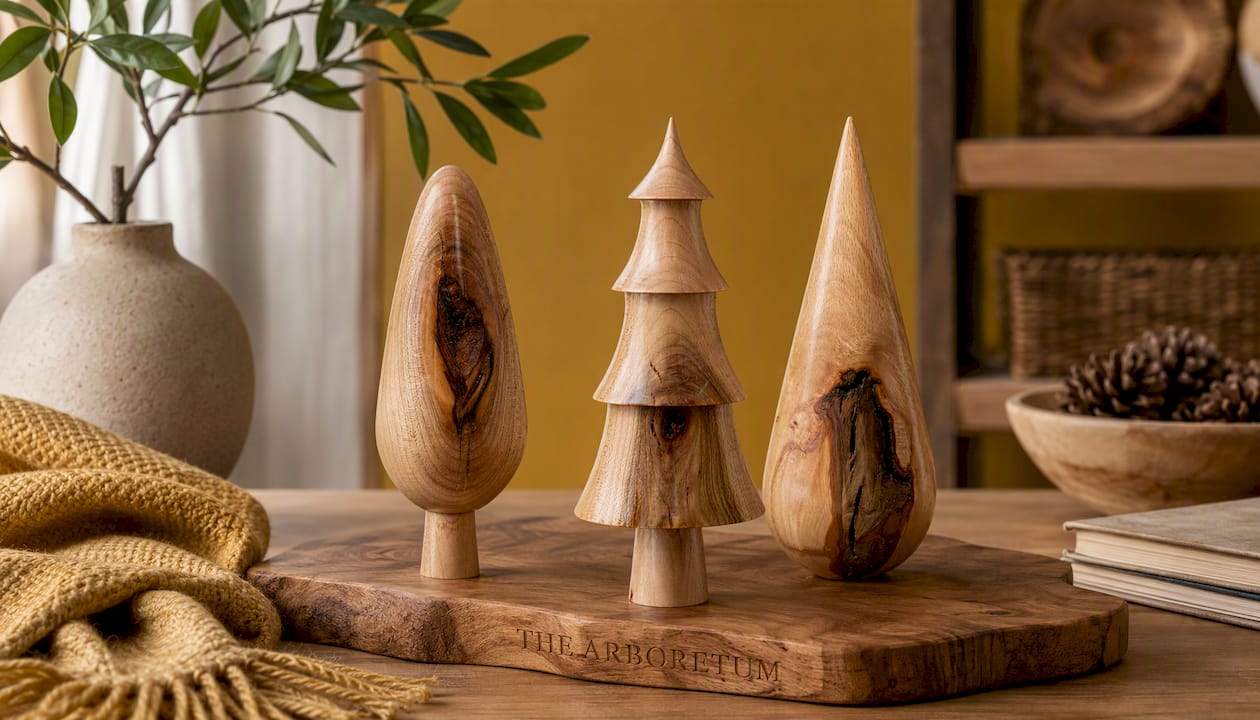
Thearboretum’s knotty maple range channels exactly the character that draws people to burl in the first place: dense knotting, unpredictable grain, no two pieces alike. The Knotty Maple Bush works as a striking standalone gift or a centrepiece for a seasonal display. The Knotty Maple Alpine suits anyone after a slightly more refined, tapered silhouette. And the Knotty Maple Drop, smaller and hangable, makes an easy keepsake or add-on gift.
Every piece uses child-safe, food-safe finishes where relevant, so they suit family homes as easily as a collector’s shelf. Browse the full range and pick the piece that matches your space at Thearboretum’s shop.
Sources
For readers who want to dig further into the botany and craft behind burl wood, the University of Connecticut’s Home Garden Education Office offers solid grounding in tree health and burl biology. Northern Woodlands covers the practitioner history and poaching issues in detail, while WoodworkingHistory.com and Canadian Woodworking go deeper on working techniques. Wikipedia’s burl entry remains a reliable general overview.
- Burl — Wikipedia
- Woodworkinghistory
- Tree burls — Home Garden Education Office, University of Connecticut
- Go figure: how tree burls grow — Northern Woodlands
Follow Us On Social