

A genuinely handmade ornament comes with evidence: a named maker, a clear account of how it was made, materials you can see and trace, and claims the seller can back up. If a listing offers only warm adjectives, treat it with caution. Below are the checks we use ourselves, what UK advertising and consumer rules say about “handmade”, and how to apply it all to wooden tree decorations.
TL;DR
- Ask who made the piece, where, and how. A real maker answers in specifics, not slogans.
- In wood, natural variation is the best signal: no two knots, grain lines or tones match across pieces.
- “Handmade”, “sustainable” and “locally made” are claims the UK advertising regulator expects sellers to substantiate.
- For children, look for dull points, a safe finish and no small parts that can pull off, and read the safety information, not just the product photo.
- Goods must match their description under UK consumer law, so keep the listing and the packaging details.
Table of Contents
- What “handmade” should actually mean
- Handmade, hand-finished or handmade-style
- Five checks before you buy
- Reading the wood itself
- Checking “sustainable”, “local” and “one of a kind”
- Safety is part of authenticity
- Your rights if the description is wrong
- A quick buyer’s script
- Where to see this in our range
- Display and care once they arrive
- FAQ
- Sources
What “handmade” should actually mean
There is no single legal definition of “handmade” for ornaments in the UK. What exists is a duty not to mislead. The Advertising Standards Authority (ASA) has made this plain in recent rulings. In 2025 it examined a boot seller whose marketing said the products were handmade by a man called Henry. The ASA understood that Henry was not a real person and had seen no evidence that he made the boots, and it found the claims misleading and unsubstantiated.
The lesson for a buyer is useful. A friendly maker’s name and a cosy story prove nothing on their own. The seller should be able to show that the product was made as described. That is also the standard a decent maker welcomes, because it separates them from imitators.
For wooden ornaments, “handmade” in a sensible sense means a person shapes, finishes and checks each piece, even if a machine does a rough cut along the way. What matters is that the description is honest about which steps are done by hand. If a listing says “handmade” and every piece looks identical to the millimetre, ask a question.
Handmade, hand-finished or handmade-style
Three phrases look alike and mean different things.
| Phrase | What it usually means | What to ask |
|---|---|---|
| Handmade | A person made the piece from start to finish, or the key steps | Who made it, and which steps are by hand? |
| Hand-finished | Made in a factory or workshop, then sanded, painted or polished by hand | What was done by machine, and what by hand? |
| Handmade-style or artisan-look | Mass-produced to resemble craft | Is the maker named, and are the pieces genuinely different from each other? |
The ASA’s 2024 ruling on a leather goods company shows how easily the lines blur. The company had said that each item was handmade in Italy. The ASA found the claim misleading without evidence covering both product lines, because one range was described as bespoke and made in Italy, while the other was hand-finished. A single sweeping sentence had covered two different production methods.
When you read an ornament listing, look for the same pattern: one confident phrase applied to everything in the shop. Honest makers tend to describe differences between ranges, and to say which pieces are one-offs and which are repeatable designs.
Five checks before you buy
1. Is there a real maker behind it?
Look for a named person or small team, a workshop location, and a way to ask questions. A shop that cannot tell you where its ornaments are made, or whose “about” page says nothing concrete, is asking you to trust a mood rather than a fact.
2. Can the seller explain the process?
Buyers value insight into how something is made. The Crafts Council’s market research found that people still prefer buying directly from makers and that the making process matters to them. Photos of the bench, the offcuts and the raw timber are harder to fake than a polished studio image. Ask how a piece is cut, sanded and finished.
3. Is the evidence specific?
In the collecting world, attribution is credible when it ties a person to a particular object or design, through documents such as invoices, commissions or prototypes. You do not need an archive for a tree decoration, but the principle carries over: a specific detail (the wood species, the workshop, the batch) beats a general boast.
4. Do the pieces vary?
This is the simplest physical test for wood. Real timber has knots, grain changes and colour shifts. If you buy a set and every piece is perfectly uniform, it was probably produced by a process designed to remove variation. If you can see the natural character and the seller says it is intentional, that is a good sign.
5. Does the finish and construction hold up?
Run a thumb over edges and joins. Check that the surface is smooth where small hands will touch it, that nothing wobbles, and that any hanging fitting is secure. Good handwork is visible in the places a hurried process skips.
Reading the wood itself
With wooden tree decorations, the material tells part of the story. Maple is pale and fine-grained; walnut is darker, with richer swirls; oak has a bolder, open grain. Knots, small checks and colour changes are not defects to be hidden. They are the record of that particular piece of timber, and they are why one tree in a set never quite matches the next.

Two practical points. First, ask which species the piece is made from, and expect a straight answer. Second, be wary of listings that call everything “solid wood” without naming it, or that show glossy images that look more like plastic than timber.
If you plan to keep ornaments for years, care matters too. We explain how to look after them in our guide to cleaning wooden ornaments, including why to test a method on a hidden spot first.
Checking “sustainable”, “local” and “one of a kind”
These three phrases do a lot of selling, so they deserve the most scrutiny.
Sustainable. UK guidance for environmental claims says they should be accurate, clear, current and backed by credible evidence, explain any relevant conditions, and not hide material information. That guidance was written by a jewellery trade body, but the logic applies to any maker. A vague “eco-friendly” with nothing behind it does not meet it. A good claim says what is sustainable (the timber source, the packaging, the finish) and how you can verify it. Our own advice on this is in how to verify FSC chain of custody for wooden decor.
Locally made. Ask where the making happens, not just where the company is registered or where the parcel ships from. “Designed in” and “made in” are different statements, as the ASA’s Italian leather ruling above illustrates.
One of a kind. Genuine one-offs are rare in any shop that sells sets. A fairer test is whether each piece is individual because of its material and handwork, which is true of timber with natural knots, rather than whether it is literally unique in the world. Be sceptical of anyone who promises both a perfectly matched set and total uniqueness.
Provenance is a fuller idea than a slogan. One commentator describes real material provenance as mappable, traceable data, such as the source of a raw material, rather than romantic, vague description. For a home buyer, a sensible version is simple: where the wood came from, what finish was used, and who handled it.

Safety is part of authenticity
A piece that is honestly handmade can still be unsuitable for a toddler’s reach, and a piece that looks like craft can be an unregulated import. Safety information is one of the clearest tests of a serious seller.
Under the General Product Safety Regulations 2005, all suppliers, including small home-based businesses, must make sure products placed on the market are safe and give adequate warnings and instructions. Council guidance adds that producers should consider how children may interact with a product and reduce risks such as choking on parts that pull off.
The official recall pages show what happens when this goes wrong. A 3D-printed dragon sold as a desk ornament or fidget toy was recalled for choking risks from detachable parts and for failing to meet the Toys (Safety) Regulations 2011. It is a reminder that calling something an ornament does not remove the duty to think about children.
For wooden tree decorations at home, we suggest these checks:
- Points and edges. Look for rounded or dull tips on anything a child can reach. We explain why in what dull point ornaments are.
- Finish. Ask what the surface is treated with. For children’s use, a food-safe finish is a sensible thing to look for.
- Small parts. Anything that can twist or pull off needs a second look.
- Hanging. Open S-hooks can catch skin and be mouthed by pets; see ornament hook safety.
- Placement. Heavy pieces belong on sturdy branches or shelves, as in our guide to hanging heavy ornaments safely.
- Reach. Our full parent guide is child-friendly Christmas tree safety for wooden ornaments.
If you are buying for a baby or very young child, remember that a decoration is not a toy, and follow any age warning the seller gives.
Your rights if the description is wrong
Authenticity is also a consumer-law matter. Under section 9 of the Consumer Rights Act 2015, goods must be of a standard a reasonable person would consider satisfactory, taking account of their description, price and other circumstances. Public statements about characteristics in advertising or labelling are relevant to that assessment.
In practice this means: screenshot or save the listing, keep the order confirmation, and note any claims about materials or making. If the item arrives and clearly does not match what was promised, you have a record to point to. If a seller will not help, Citizens Advice is the usual route for guidance on next steps.
The same logic applies to gifts. If you are buying for someone else, read our notes on UK safety, FSC proof and packing for wooden gift ornaments, so the recipient gets what the listing described.
A quick buyer’s script
When in doubt, send the seller these five questions. A genuine maker will usually enjoy answering.
- Who makes these, and where?
- Which steps are done by hand and which by machine?
- What wood is this, and where does the timber come from?
- What finish is on it, and is it suitable for children?
- Will each piece look exactly like the photo, or will the grain and knots differ?
The fifth question is a good tell. A maker who works with real timber will say that each piece differs. A seller of look-alikes will say they are all identical.
Our view on authenticity
We make wooden tree decorations because we were tired of ornaments that looked the same on every shelf. Our trees are crafted from sustainably sourced hardwoods such as maple, walnut and oak, and we leave the natural knots and textures visible. They are not flaws to sand away. They are the reason each tree has its own character.
For us, authenticity is not a label. It is the willingness to answer awkward questions: what the wood is, how the piece is shaped, what the finish is, and who it is safe for. That is why we offer child-friendly versions with dull points and food-safe finishes, and why we pack orders in eco-friendly packaging.
If you are choosing between a perfect-looking set and one with real grain, choose the one that tells you where it came from. A decoration should carry a story you can actually check.
Josh
Where to see this in our range
If you would like to see natural knots and grain in practice, our Woodland sets start at $126 and come in several variations, including a child-friendly version and an oak version. The larger Forest sets are $239. If you want a single piece or something personal, the custom collection includes a Custom Single Tree at $28.
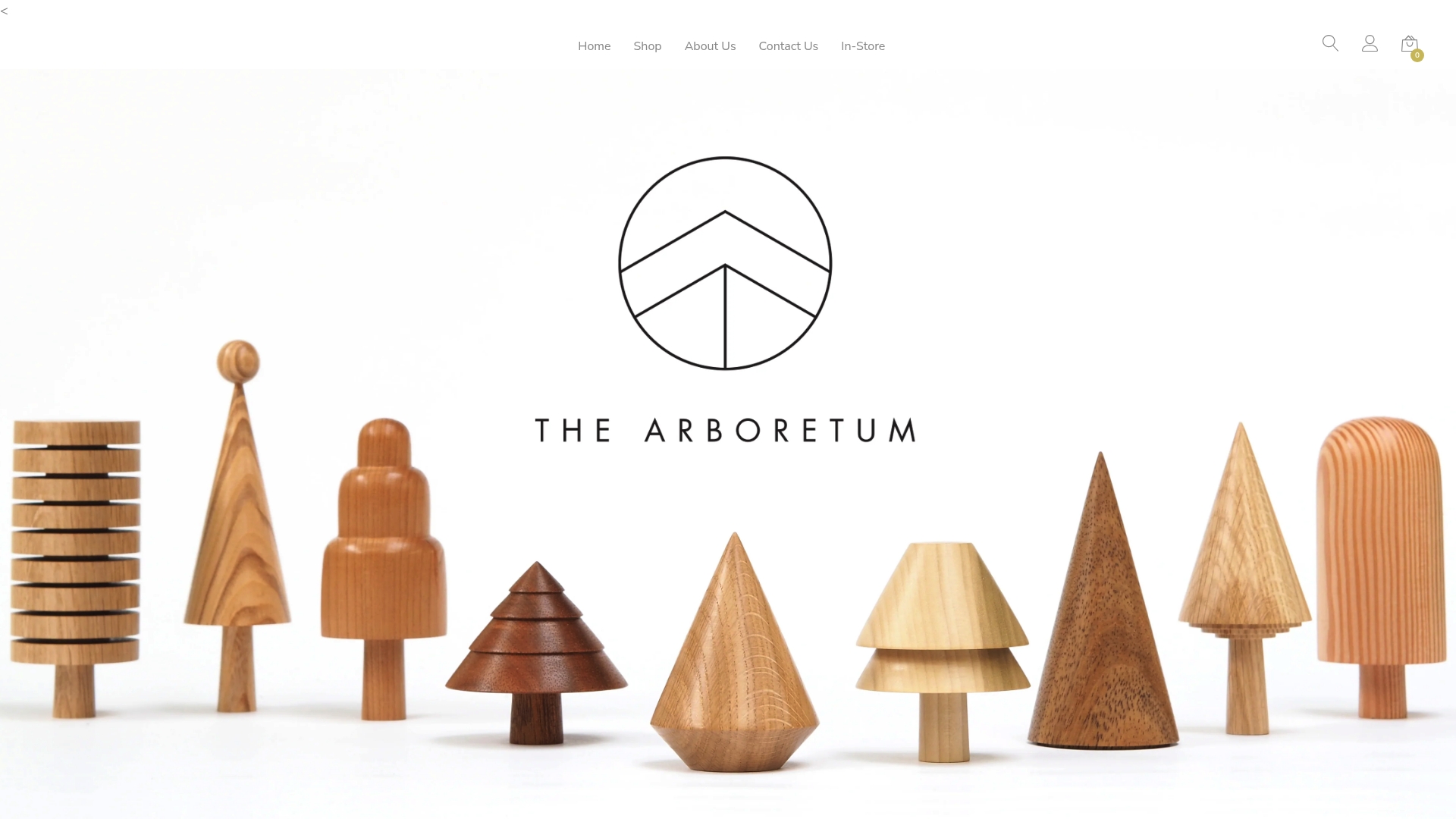
The Floating Shelf and Tree Candle, both $40, are in our new trees collection. Prices are as published on our site, so check the shop for the current figure before ordering.
Display and care once they arrive
An authentic piece deserves to be shown properly. Keep wooden trees away from radiators and damp, and place them where family and pets will not knock them. Our ornament display ideas for UK homes cover arrangements that work even when small hands can reach them. If you collect, a simple note of the purchase date, the seller and the wood species will help you keep a provenance record of your own.
Larger decorations are a separate decision, and we have written about oversized wooden ornaments for readers who want a statement piece.
FAQ
How can I tell if a wooden ornament is really handmade?
Look for visible variation in grain and knots, a named maker, and a clear explanation of the process. Ask which steps are done by hand. If every piece looks machine-identical and the seller cannot describe how they are made, be cautious.
Is “handmade” legally protected in the UK?
There is no single legal definition for ornaments, but sellers must not mislead. The ASA has ruled against “handmade” claims that were not backed by evidence, so a seller should be able to show that products were made as described.
Are handmade ornaments safe for children?
Not automatically. UK law requires products to be safe and carry adequate warnings, but you should still check for sharp points, small parts that pull off and the finish. Look for child-friendly designs with dull points and a food-safe finish, and follow any age guidance.
What can I do if an ornament does not match its description?
Keep the listing and order confirmation. Under the Consumer Rights Act 2015, goods should be of satisfactory quality, and statements in advertising are relevant. Contact the seller first, then seek advice from Citizens Advice if needed.
Sources
- ASA Ruling on Person(s) Unknown t/a Henry’s Boots
- ASA Ruling on Sterling Wholesale Ltd t/a Moncrief
- Crafts Council, The Market for Craft (executive summary, 2020)
- Artist, Designer and Maker Biographies, Collectaneum
- NAJ Guidance Note on environmental claims
- Material Provenance Documentation: 5 Trusted Audit Steps
- Candles, Wax Melts and Reed Diffusers consumer protection information pack
- Product Recall: 3D Printed Dragon Fidget Toy sold via eBay
- Consumer Rights Act 2015, section 9
Follow Us On Social